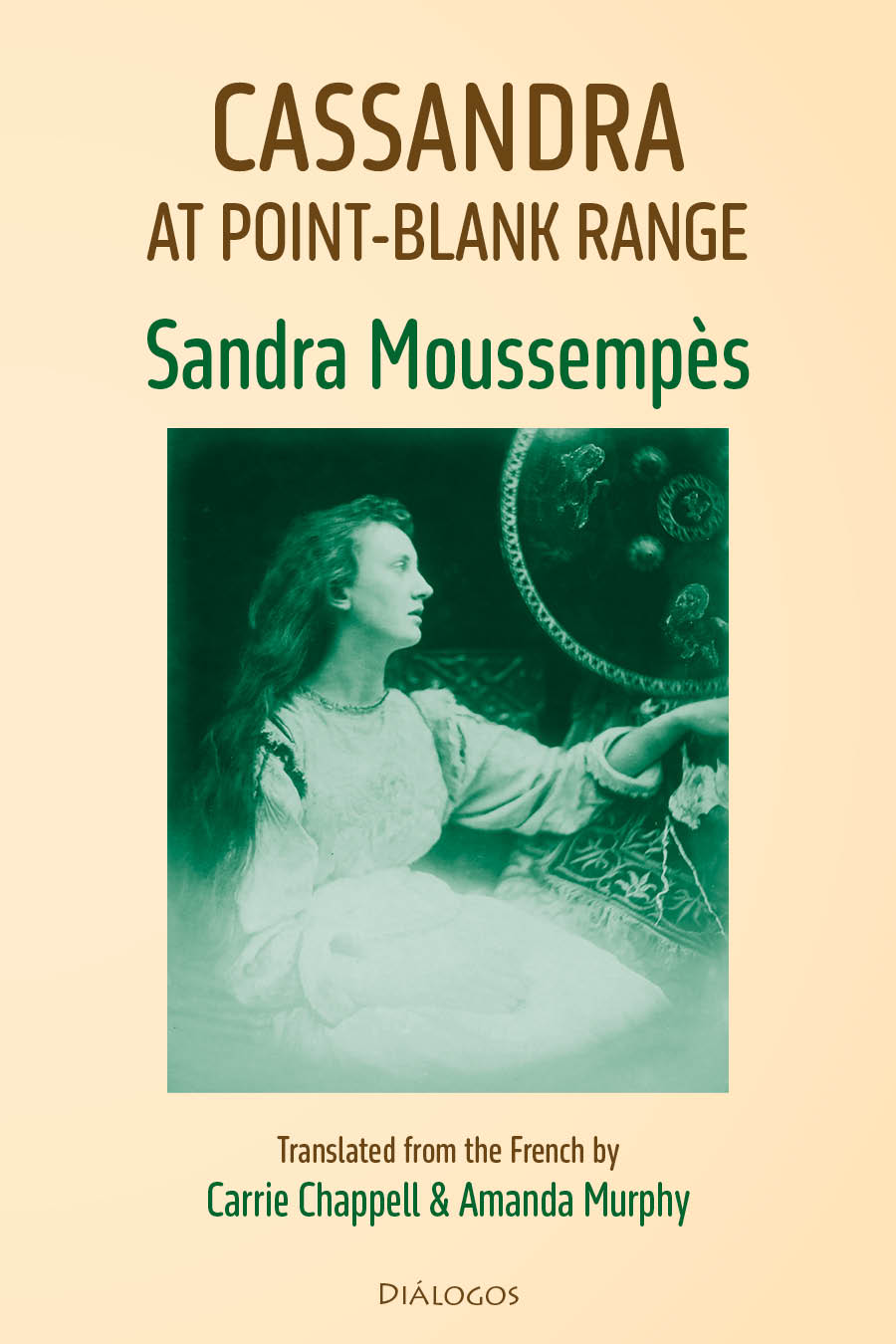
Winner of the Théophile Gauthier Prize from the French Academy, Cassandra at point-blank range is the first full-length translation of revered French feminist poet Sandra Moussempès. Cassandra channels and weaves the voices of heroines including Emily Dickinson, Sylvia Plath, Mary Shelley, Cindy Sherman, Gaspara Stampa, Virginia Woolf, Unika Zürn, and Taeko Kono, as well as mythical figures like Lilith, Iphigenia, and Cassandra, to explore the depth of the Western feminine psyche. Through Moussempès’ imagistic, layered poetics, readers encounter the corporality of being a woman among women and of making poetry with women, a process that this edition, translated by Carrie Chappell and Amanda Murphy, continues by “giving body” to Moussempès’ work in English.
Parution : Lavender Ink/Dialogos, avril 2025
À propos de l'ouvrage
Quatrième de couverture :
« From within the galaxy of French poetics, Sandra Moussempès’ work glimmers like the foreign body of a rare star…. »
–Liliane Giraudon, Author of Love Is Colder than the Lake and Sphinx
« There is something almost oceanic and tidal about the work of Sandra Moussempès. The formal expansion and contraction seems to mold to the way the theme of female embodiment runs across these poems »
—Marissa Davis, Author of End of Empire and My Name & Other Languages I Am Learning How to Speak
Moussempès’s writing doesn’t enshrine women but traces their fates and contemplations, much as French surrealist/avant-garde cinema and Dada-influenced movements sought to evoke irrational imagery as a challenge to traditional narrative. Consider Moussempès’s deeper meaning then, especially with subtitles like “Unidentified feminine objects.” What saves this collection from a lack of connectivity is its creative body politic and feminist surrealism à la Leonora Carrington, whereby an artist explores female identity and agency as they reject the idea of being seen as an object, by creating their own objectivity.
Moussempès’s poems speak of and to women, where the necessity of acute French or English expression is less important than the narration of women’s lives through the senses. As she says: “The secret allowed me to come and go fearlessly.” Translation is a practice that reworks something into another form of existence: “To my voice found in a recessed answering machine” (“Prosody of Welcome”). Moussempès has filled a void whose historic rigid exclusions of diversity and dictations that poetry should have strict formal structure canceled French poetry for many.
While women and people of color are underrepresented in French poetry, Moussempès’s writing rejects stifling former values without adopting new ones. Instead, she’s unburdened in an urge to speak without restraint, rule, or structure. At times, the language doesn’t really make conventional sense; this is deliberate. Don’t force understanding; the intention is to experience. In the poem “Doubles,” surrealism recalls Twin Peaks’s (1990) mirroring, shuffling effects, alongside Blue Velvet’s (1986) dissolution of femininity, with tinges of The Shining’s (1980) horror and the neon-blinking loss and gain of self in Jean-Claude Tramont’s All Night Long (1981).
Candice Luisa Daquin, Wold Literature Today, June 2026
Following the 2015 English translation of Sunny Girls, Paris-based Sandra Moussempès’s new release is a masterwork in abstract feminist poetry. Cassandra at point-blank range is an exciting new collection that is teeming with inspiration from a wide swath of historic feminine champions, as well as the everyday, film-like experiences of the poet herself. Translated with an astute attention to detail, and crisp, continuous tonality, Carrie Chappell and Amanda Murphy have offered us a glimpse into the amorphous and readily engaged mind of Moussempès across a patchwork of fever dream spaces, where reality twists and turns, and language is the cohesive element binding shared experience, necessary history, and the grim but defiant inquiry of conflict and resistance, together.
Greb Bem, literary journal, Exacting Clam USA